It is now official, a second gifted-talented kid inhabits our house: Boy.
The school district tested him and qualified him for their advanced program. God have mercy on them all. He starts K next year.
Thursday, 25 May 2006

What will it take?
Does one need any further or better or more clearly-defined reason for the US Department of Defense to halt the use of the Social Security number as an identifying number, than this one?
Emphasis mine.
Will we soon have some veteran, with the plastic tubes shoved up his nose to deliver his life-preserving oxygen, bitching to Congress about how his identity has been stolen, how his mil pension is now redirected to a meth lab on the other side of the Mississippi? How about a Korean-era serviceman's widow dumped on the curb because she couldn't make her rent payments, because her identity was stolen?
Will it have to come to that?
This is an official announcement from The Enlisted Association of the National Guard, of the United States (EANGUS).
Theft of Veterans Affairs (VA) Personal Data
Monday, May 21, 2006. The Department of Veterans Affairs (VA) has recently learned that an employee, a data analyst, took home electronic data from VA, which he was not authorized to do. This behavior was in violation of our policies. This data contained identifying information including names, social security numbers, and dates of birth for up to 26.5 million veterans and some spouses, as well as some disability ratings.
Emphasis mine.
Will we soon have some veteran, with the plastic tubes shoved up his nose to deliver his life-preserving oxygen, bitching to Congress about how his identity has been stolen, how his mil pension is now redirected to a meth lab on the other side of the Mississippi? How about a Korean-era serviceman's widow dumped on the curb because she couldn't make her rent payments, because her identity was stolen?
Will it have to come to that?
Tuesday, 18 April 2006
Monday, 3 April 2006
Fa bene
One of the Christmas gifts from years past I finally got around to trying: pasta attachments that mate to the massive frigging power-take-off on the premium stand mixer I got for my Sainted Wife whom I do not deserve.
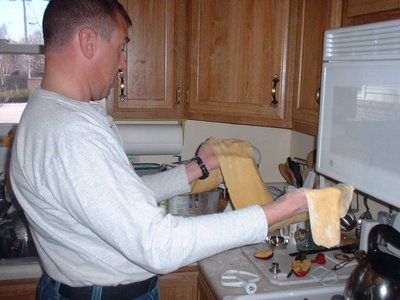
That was fun. Amazing how two cups of flour turns into a patch of noodle dough 10 centimeters wide by 10 meters long (though only microns thick).
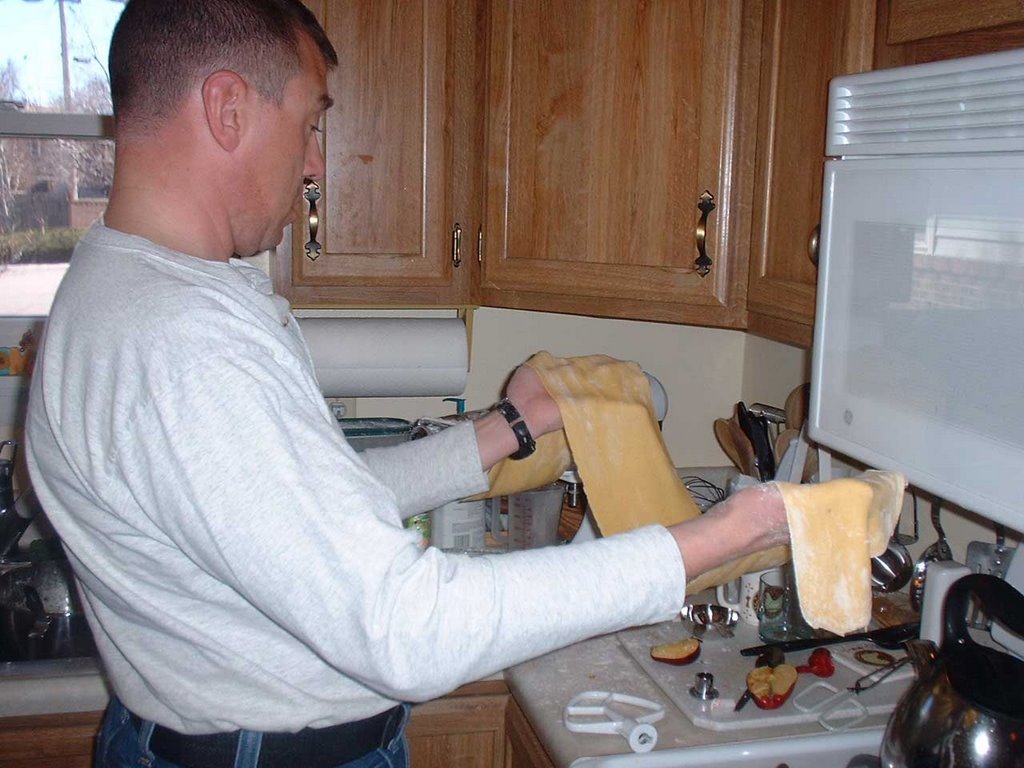
That was fun. Amazing how two cups of flour turns into a patch of noodle dough 10 centimeters wide by 10 meters long (though only microns thick).
Sunday, 2 April 2006
Bike'n'shoot
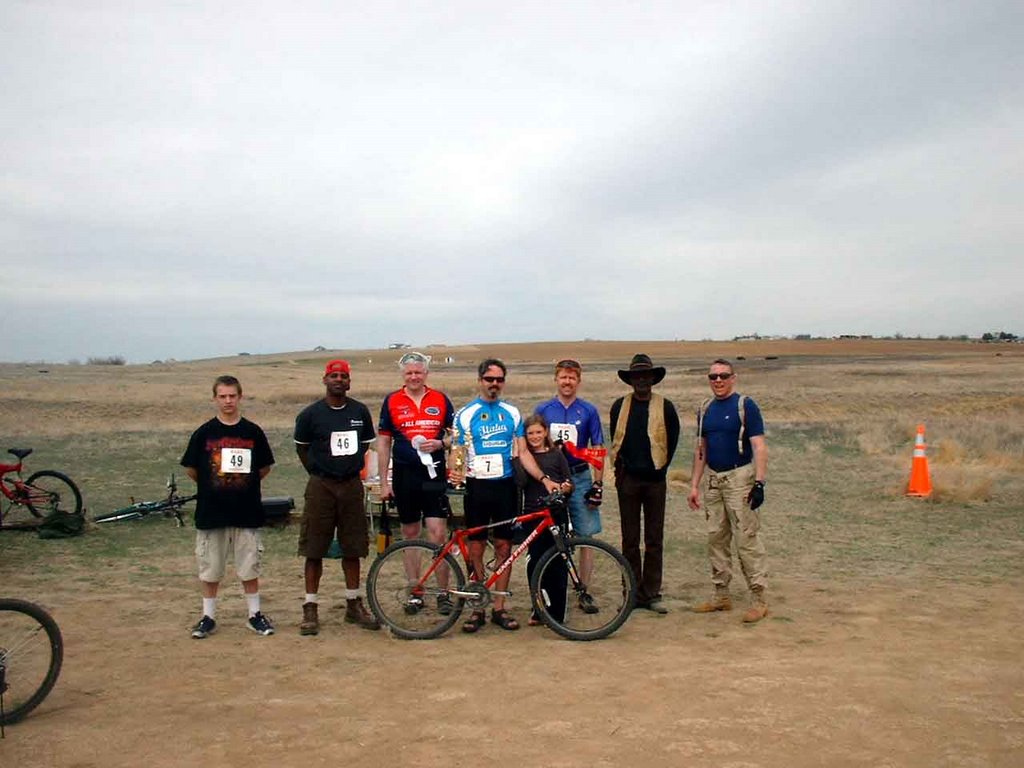
TCM and I met at the Bike'n'shoot. TCM, avid cyclist and dedicated shooter, placed.
Fûz finished without dying. He's the guy sucking wind on your right. TCM remains incognito.
Wednesday, 15 March 2006
Gas piston upper for AR15
File this under Noodling.
One repeated criticism of the AR15 design is its direct gas impingement action. Propellant gas is tapped from the barrel and led through a tube backwards into the receiver of the piece, and into the bolt carrier itself. The gas pressure works against a piston which is a rearward-facing surface of the bolt. The pressure builds between that face of the bolt and the internal surfaces of the bolt carrier ('directly impinging' upon the bolt), forcing them apart. A cam translates that force into rotation of the bolt, so its lugs disengage with their mating surfaces, the bolt unlocks, and the bolt carrier can retract, carrying the bolt with it.
The propellant gas passing through the bolt carrier leaves a mess behind, as a carbon buildup that has to be cleaned out, or it will build up to the point that the piece malfunctions.
The upside? Fewer parts and less weight compared to a firearm that contains this gas in a cylinder up front of the receiver, and uses the pressure to move an operating rod. In an indirect-impingement firearm, the operating rod moves the bolt carrier without depositing burnt-propellant crud in the receiver.
So the noodling goal is to improvise an operating rod that weighs the least possible and fits within the AR15 footprint--or a footprint expanded to what the market will accept.
Picatinny-rail forearms are the rage. A free-floating tube takes the place of the original AR15-type forearm nowadays, and Weaver-type rails are fastened to or forged integrally with the tube at 12, 3, 6 and 9-o'clock positions. Plenty of room exists within to contain a few grams of extra hardware.
The extra hardware consists of a spigot and an operating rod, fitting into a replacement gas block. The photo shows the first two parts and omits the gas block.

The spigot is up front and the op rod is to the rear. The spigot's rear section has an outer diameter that just matches the inner diameter of the op rod's frontward cylinder; the spigot's rear is male to the op rod's forward female. Cannelures are turned into the spigot's rear section to reduce weight and give the crud someplace to collect until the rifleman has time to take it out and clean it.
What the photo does not show is the yoke ("gas block"), the part that is fastened to the carbine barrel and is bored to take the spigot. The forward, thicker section of the spigot has keyways milled into it so it quarter-turns into the yoke to fasten there.
The yoke has a port bored in it so a hole in the barrel lets propellant gas out, through the port, into a matching port in the spigot. The spigot then redirects the propellant gas rearward into the op rod.
As the gas passes through the port, into the spigot, it enters the op rod's cylinder, filling it and pushing it rearwards.
A spring surrounds the rear tail of the op rod, and that spring compresses as the op rod retreats. The op rod's tail has the same diameter, minus x, as the original gas tube of the AR15, so it easily passes into the upper receiver and enters the bolt carrier key. The op rod tail pushes against the bolt carrier key, so when the op rod retreats, it pushes the bolt carrier key as surely as gas pressure in the tube would.
When the op rod retreats far enough, the rearmost face of the spigot is exposed, and the gas that filled the op rod cylinder can escape. No gas is introduced into the upper receiver along this route. The bolt carrier, having more mass than the op rod, keeps going rearward. The op rod runs out of gas, so to speak, and its return spring pushes it home again, back over the rear tail of the spigot.
The spigot guides the op rod's cylinder back home; only a millimeter or two of the op rod's travel will not be guided by the spigot, so there will be no need of a tube or rail to guide the op rod.
When the shooting day is ended, the operator can turn the spigot a quarter-turn or so, pull the spigot forward out of the yoke, and clean it off. The op rod will also come forward, through the yoke, and out the front of the carbine so its cylinder can be cleaned out. The op rod's cylinder's outer diameter is less than the inner diameter of the yoke's spigot passage.
Reassembly is reverse of disassembly.
All of it should fit within the confines of the modern Picatinny-railed handguard. Some propellant junk will accumulate within that handguard but that won't interfere with operation of the carbine. A toothbrush will get it out. Some tuning of internal surfaces of the handguard may be necessary to guide the op rod on its travel, and to buffer the op rod's return spring.
The challenges? First, to make the parts very light. If the walls of the op rod's cylinder are thin enough, they'll heat up in protracted fire so propellant gunk will burn off rather than build up. Too thin, though, and the walls will rupture. The yoke and spigot have to be kept light too. All of it will have to be steel rather than aluminum alloy, to resist the burning propellant gases.
Another problem would be the bowing of the tail of the op rod under firing pressure. If it flexes or bows too much it will bind against the hole in the upper receiver instead of shoving the bolt carrier rearward. Maybe the tail could be peened with flats so it will bow at more nodes but with less amplitude. This will be less of a problem with shorter-barreled carbines, such as the M4, because the tail will be shorter than that of the A3 rifle, with same diameter, thus stiffer.
One repeated criticism of the AR15 design is its direct gas impingement action. Propellant gas is tapped from the barrel and led through a tube backwards into the receiver of the piece, and into the bolt carrier itself. The gas pressure works against a piston which is a rearward-facing surface of the bolt. The pressure builds between that face of the bolt and the internal surfaces of the bolt carrier ('directly impinging' upon the bolt), forcing them apart. A cam translates that force into rotation of the bolt, so its lugs disengage with their mating surfaces, the bolt unlocks, and the bolt carrier can retract, carrying the bolt with it.
The propellant gas passing through the bolt carrier leaves a mess behind, as a carbon buildup that has to be cleaned out, or it will build up to the point that the piece malfunctions.
The upside? Fewer parts and less weight compared to a firearm that contains this gas in a cylinder up front of the receiver, and uses the pressure to move an operating rod. In an indirect-impingement firearm, the operating rod moves the bolt carrier without depositing burnt-propellant crud in the receiver.
So the noodling goal is to improvise an operating rod that weighs the least possible and fits within the AR15 footprint--or a footprint expanded to what the market will accept.
Picatinny-rail forearms are the rage. A free-floating tube takes the place of the original AR15-type forearm nowadays, and Weaver-type rails are fastened to or forged integrally with the tube at 12, 3, 6 and 9-o'clock positions. Plenty of room exists within to contain a few grams of extra hardware.
The extra hardware consists of a spigot and an operating rod, fitting into a replacement gas block. The photo shows the first two parts and omits the gas block.
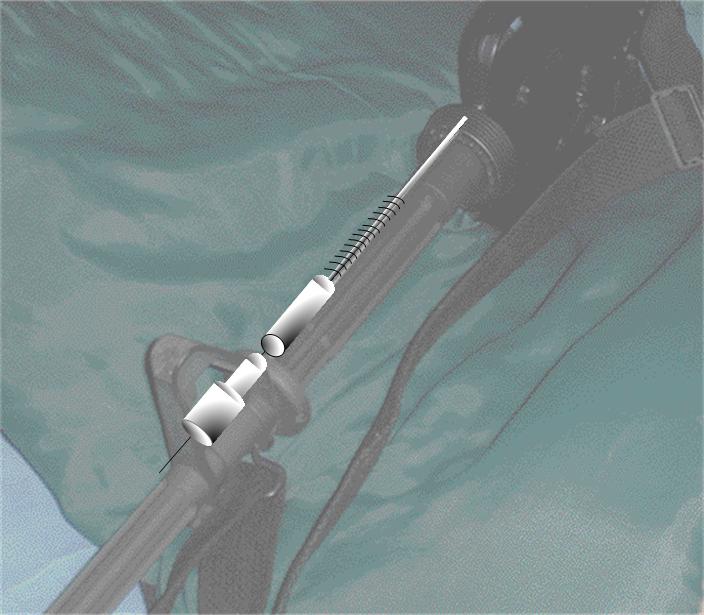
The spigot is up front and the op rod is to the rear. The spigot's rear section has an outer diameter that just matches the inner diameter of the op rod's frontward cylinder; the spigot's rear is male to the op rod's forward female. Cannelures are turned into the spigot's rear section to reduce weight and give the crud someplace to collect until the rifleman has time to take it out and clean it.
What the photo does not show is the yoke ("gas block"), the part that is fastened to the carbine barrel and is bored to take the spigot. The forward, thicker section of the spigot has keyways milled into it so it quarter-turns into the yoke to fasten there.
The yoke has a port bored in it so a hole in the barrel lets propellant gas out, through the port, into a matching port in the spigot. The spigot then redirects the propellant gas rearward into the op rod.
As the gas passes through the port, into the spigot, it enters the op rod's cylinder, filling it and pushing it rearwards.
A spring surrounds the rear tail of the op rod, and that spring compresses as the op rod retreats. The op rod's tail has the same diameter, minus x, as the original gas tube of the AR15, so it easily passes into the upper receiver and enters the bolt carrier key. The op rod tail pushes against the bolt carrier key, so when the op rod retreats, it pushes the bolt carrier key as surely as gas pressure in the tube would.
When the op rod retreats far enough, the rearmost face of the spigot is exposed, and the gas that filled the op rod cylinder can escape. No gas is introduced into the upper receiver along this route. The bolt carrier, having more mass than the op rod, keeps going rearward. The op rod runs out of gas, so to speak, and its return spring pushes it home again, back over the rear tail of the spigot.
The spigot guides the op rod's cylinder back home; only a millimeter or two of the op rod's travel will not be guided by the spigot, so there will be no need of a tube or rail to guide the op rod.
When the shooting day is ended, the operator can turn the spigot a quarter-turn or so, pull the spigot forward out of the yoke, and clean it off. The op rod will also come forward, through the yoke, and out the front of the carbine so its cylinder can be cleaned out. The op rod's cylinder's outer diameter is less than the inner diameter of the yoke's spigot passage.
Reassembly is reverse of disassembly.
All of it should fit within the confines of the modern Picatinny-railed handguard. Some propellant junk will accumulate within that handguard but that won't interfere with operation of the carbine. A toothbrush will get it out. Some tuning of internal surfaces of the handguard may be necessary to guide the op rod on its travel, and to buffer the op rod's return spring.
The challenges? First, to make the parts very light. If the walls of the op rod's cylinder are thin enough, they'll heat up in protracted fire so propellant gunk will burn off rather than build up. Too thin, though, and the walls will rupture. The yoke and spigot have to be kept light too. All of it will have to be steel rather than aluminum alloy, to resist the burning propellant gases.
Another problem would be the bowing of the tail of the op rod under firing pressure. If it flexes or bows too much it will bind against the hole in the upper receiver instead of shoving the bolt carrier rearward. Maybe the tail could be peened with flats so it will bow at more nodes but with less amplitude. This will be less of a problem with shorter-barreled carbines, such as the M4, because the tail will be shorter than that of the A3 rifle, with same diameter, thus stiffer.
Monday, 6 March 2006
My car is my property, continued and revised
Please let me clarify some points about this earlier post.
I do not support a law that explicitly establishes a right to have a firearm in one's car while on an employer's property.
I do support a law that establishes an automobile as a person's property, protected with the same Fourth Amendment rights as one's papers, effects, and home.
I'm still wrestling with the idea that one can enter a contract that requires one to surrender a civil right. I've been wrestling with that idea for decades and probably will continue to do so in my grave. It's for greater minds than mine. Maybe Jed is right, interfering here is an impairment of the right of contract.
Some of my concerns arise from how one can be held to "enter a contract" by buying a house or entering a business, or taking a job. To me, it's not a contract unless it is for a fixed beginning and end dates, among person or persons identifiable, with consequences for failure to meet the stipulations of the contract on all parties, and a means to terminate the contract. There is only one entity with whom I have actually entered an employment contract, and it did indeed demand the circumscription of some of my civil rights, but that's because it's the frigging US military. They are a different animal entirely from being a grocery bagger, newspaper carrier, or cable geek, and ought to be. None of those other entities ran a contract past me. In the case of cable geekery, they tried: headhunters told me those attempts weren't contracts and are unenforceable.
Taking a job with a papermill is not necessarily entering a contract. Agreeing to take that job does not equate to implicit consent for the papermill's ownership to search my car while it is parked on their property in the course of my working there. Union work may differ.
What would make a "gun-free workplace" more palatable would be law or jursiprudence like that proposed for a "gun-free supermarket". Business A is welcome to assert its right to property over the building and grounds of its business, such that employees or patrons are forbidden from being armed while on that property. Business A knowingly surrenders indemnity for violence that occurs there, and maybe their insurer will note that fact and charge premiums accordingly.
Business A must also bear some costs---not directly financial, as in fines, but operating costs, signage, storage---to make sure its employees and customers know their choice and can comply with it at the place where they cross that boundary between public property and Business A's private property.
Business B chooses not to establish such a policy, and Business B is protected by law from any suit holding it responsible for violence that occurs there, provided Business B is not the perpetrator. Please read the comments to the post I linked immediately above, they illuminate.
Absent this kind of law, we have recourse only to public pressure. PR has discouraged businesses who were weighing "gun-free" policies for their customers: Burt auto dealerships in the Denver area, for example, responded positively to a call-and-write'em campaign; I've heard that Applebee's did also.
But if workplace violence is as prevalent as some say (well, is it?), and workplace violence succeeds in spite of "gun-free" workplace policies (leave the "because of" argument for another day), then employees are at greater risk than patrons. What about them? Failing to protect employees' RKBA is, in my view, implicit acceptance of the principle that the presence of a gun causes crime regardless of the character of the people involved: 'It doesn't matter who you are, or who your co-workers are, doesn't matter how well I checked you out before I hired you. If the gun is there somebody might get hurt.'
Distinctions regarding what really constitutes private property take on new meaning here, and I stress them.
*******
Jed and I, and all five of my other regular readers, should be so lucky that someday the individual RKBA receives the respect and juridicial deference that are implied in this discussion. We are still trying to secure an uncertain and tragically disrespected RKBA in our own homes and on public streets; the right answers for RKBA within places of employment, worship, and commerce, at some presumed distance from the purely public sphere, depend on agreement that an individual RKBA exists. Such agreement cannot exist in a nation and at a time where mere possession of the instrument in private without State permission can be a crime, or in a city whose civic leaders or sworn peace officers can unilaterally call for the instruments' wholsale seizure.
Perhaps it is a sign of progress that our legislators and courts are now weighing the RKBA against other rights, without obvious intent to use that balancing act to short-sheet RKBA. Perhaps the RKBA can be defined, in part, from the outside in---where must it recede in importance versus other rights?
I do not support a law that explicitly establishes a right to have a firearm in one's car while on an employer's property.
I do support a law that establishes an automobile as a person's property, protected with the same Fourth Amendment rights as one's papers, effects, and home.
I'm still wrestling with the idea that one can enter a contract that requires one to surrender a civil right. I've been wrestling with that idea for decades and probably will continue to do so in my grave. It's for greater minds than mine. Maybe Jed is right, interfering here is an impairment of the right of contract.
Some of my concerns arise from how one can be held to "enter a contract" by buying a house or entering a business, or taking a job. To me, it's not a contract unless it is for a fixed beginning and end dates, among person or persons identifiable, with consequences for failure to meet the stipulations of the contract on all parties, and a means to terminate the contract. There is only one entity with whom I have actually entered an employment contract, and it did indeed demand the circumscription of some of my civil rights, but that's because it's the frigging US military. They are a different animal entirely from being a grocery bagger, newspaper carrier, or cable geek, and ought to be. None of those other entities ran a contract past me. In the case of cable geekery, they tried: headhunters told me those attempts weren't contracts and are unenforceable.
Taking a job with a papermill is not necessarily entering a contract. Agreeing to take that job does not equate to implicit consent for the papermill's ownership to search my car while it is parked on their property in the course of my working there. Union work may differ.
What would make a "gun-free workplace" more palatable would be law or jursiprudence like that proposed for a "gun-free supermarket". Business A is welcome to assert its right to property over the building and grounds of its business, such that employees or patrons are forbidden from being armed while on that property. Business A knowingly surrenders indemnity for violence that occurs there, and maybe their insurer will note that fact and charge premiums accordingly.
Business A must also bear some costs---not directly financial, as in fines, but operating costs, signage, storage---to make sure its employees and customers know their choice and can comply with it at the place where they cross that boundary between public property and Business A's private property.
Business B chooses not to establish such a policy, and Business B is protected by law from any suit holding it responsible for violence that occurs there, provided Business B is not the perpetrator. Please read the comments to the post I linked immediately above, they illuminate.
Absent this kind of law, we have recourse only to public pressure. PR has discouraged businesses who were weighing "gun-free" policies for their customers: Burt auto dealerships in the Denver area, for example, responded positively to a call-and-write'em campaign; I've heard that Applebee's did also.
But if workplace violence is as prevalent as some say (well, is it?), and workplace violence succeeds in spite of "gun-free" workplace policies (leave the "because of" argument for another day), then employees are at greater risk than patrons. What about them? Failing to protect employees' RKBA is, in my view, implicit acceptance of the principle that the presence of a gun causes crime regardless of the character of the people involved: 'It doesn't matter who you are, or who your co-workers are, doesn't matter how well I checked you out before I hired you. If the gun is there somebody might get hurt.'
Distinctions regarding what really constitutes private property take on new meaning here, and I stress them.
*******
Jed and I, and all five of my other regular readers, should be so lucky that someday the individual RKBA receives the respect and juridicial deference that are implied in this discussion. We are still trying to secure an uncertain and tragically disrespected RKBA in our own homes and on public streets; the right answers for RKBA within places of employment, worship, and commerce, at some presumed distance from the purely public sphere, depend on agreement that an individual RKBA exists. Such agreement cannot exist in a nation and at a time where mere possession of the instrument in private without State permission can be a crime, or in a city whose civic leaders or sworn peace officers can unilaterally call for the instruments' wholsale seizure.
Perhaps it is a sign of progress that our legislators and courts are now weighing the RKBA against other rights, without obvious intent to use that balancing act to short-sheet RKBA. Perhaps the RKBA can be defined, in part, from the outside in---where must it recede in importance versus other rights?
Subscribe to:
Posts (Atom)